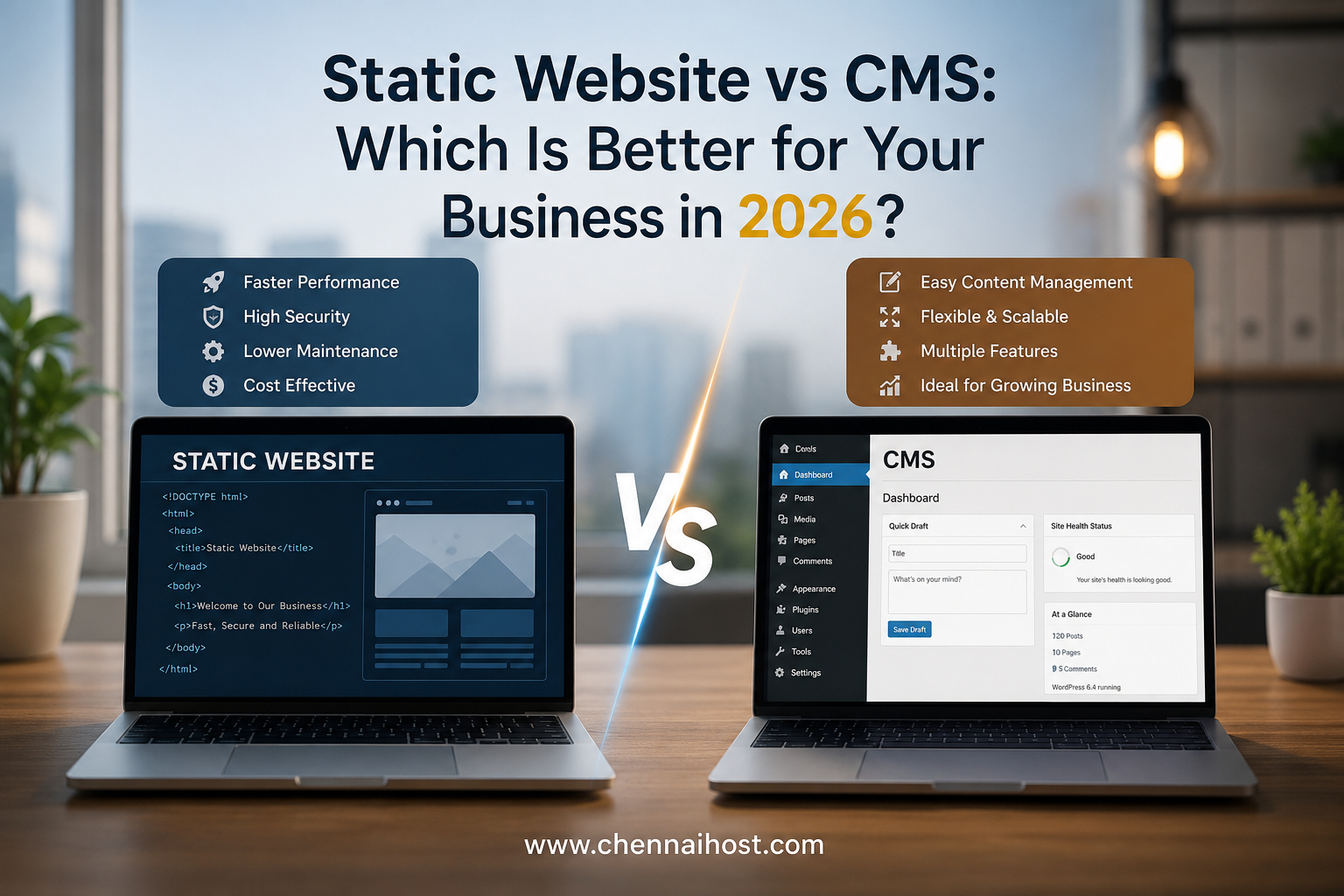
In today’s digital world, every business needs a professional website. Whether you’re launching a startup, running a local business, or expanding an established company, one important decision is choosing between a static website and a Content Management System (CMS).
Both options have their strengths, but the right choice depends on your business goals, budget, and how often you update your website. In this guide, we’ll compare static websites and CMS platforms to help you make the best decision in 2026.
What Is a Static Website?
A static website consists of fixed web pages created using technologies like HTML, CSS, and JavaScript. Each page is pre-built and delivered directly to visitors without requiring database queries for every request.
Static websites are known for their simplicity, speed, and security. They are ideal for businesses that don’t frequently change their website content.
Best suited for:
- Company profile websites
- Portfolio websites
- Landing pages
- Small business websites
- Product showcase websites
- Event websites
What Is a CMS?
A Content Management System (CMS) allows you to create, edit, and manage website content through an easy-to-use dashboard without modifying the underlying code. Popular CMS platforms include WordPress, Joomla, and Drupal.
CMS websites are designed for businesses that regularly publish or update content.
Best suited for:
- Blogs
- News portals
- E-commerce stores
- Educational websites
- Membership websites
- Businesses with frequent content updates
Static Website vs CMS
| Feature | Static Website | CMS |
|---|---|---|
| Website Speed | Excellent | Good (depends on plugins and optimization) |
| Security | Very High | Good, requires regular updates |
| Maintenance | Minimal | Regular updates required |
| Content Updates | Requires developer assistance | Easy through admin panel |
| Hosting Requirements | Low | Moderate to High |
| Scalability | Suitable for informational websites | Excellent for dynamic websites |
| Development Cost | Lower | Higher |
| Performance | Excellent | Depends on configuration |
Website Speed Matters More Than Ever
Google continues to prioritize fast-loading websites in search results. Since static websites don’t generate pages dynamically for each visitor, they generally load much faster.
Benefits include:
- Faster page loading
- Better user experience
- Improved Core Web Vitals
- Lower server resource usage
- Better SEO potential
If your website mainly presents business information, a static website can deliver excellent performance.
Security Comparison
Cybersecurity threats continue to grow each year.
Static websites have a smaller attack surface because they typically don’t rely on databases, login dashboards, or numerous third-party plugins.
CMS websites, while powerful, require:
- Regular software updates
- Plugin updates
- Theme updates
- Security monitoring
- Scheduled backups
Proper maintenance can keep a CMS secure, but it requires ongoing attention.
Ease of Managing Content
This is where CMS platforms have a clear advantage.
If your team regularly:
- Publishes blog posts
- Updates product listings
- Adds news or announcements
- Manages multiple authors
a CMS can significantly simplify day-to-day website management.
On the other hand, if your website changes only occasionally, maintaining a full CMS may be unnecessary.
Cost Comparison
A static website is often the more economical option because it:
- Requires fewer server resources
- Needs less ongoing maintenance
- Has fewer software dependencies
CMS websites may involve additional costs such as:
- Premium themes
- Premium plugins
- Security tools
- Backup services
- Regular maintenance
- Developer support for upgrades
Consider not only the initial development cost but also the long-term maintenance expenses.
SEO Performance
Both static websites and CMS websites can perform well in search engines when properly optimized.
Key SEO factors include:
- Fast page speed
- Mobile responsiveness
- Quality content
- Proper meta tags
- Structured headings
- Image optimization
- Internal linking
A well-built static website can rank just as effectively as a CMS website when these best practices are followed.
Which Option Should You Choose?
Choose a Static Website if you:
- Need a professional online presence
- Rarely update your content
- Want maximum speed and security
- Prefer lower maintenance costs
- Have a limited budget
Choose a CMS if you:
- Publish content regularly
- Manage a blog or news section
- Need multiple content editors
- Plan to expand website functionality over time
- Want to update content without developer assistance
How ChennaiHost Can Help
At ChennaiHost, we build both static and CMS websites tailored to your business needs.
Whether you need:
- A high-performance static business website
- A CMS-powered corporate website
- A WordPress solution
- A custom web application
- Reliable web hosting
- Domain registration
- Business email services
our team can recommend the most suitable solution based on your goals, budget, and future growth plans.
Final Thoughts
There is no one-size-fits-all answer when choosing between a static website and a CMS. The best option depends on how your business operates and how you plan to manage your online presence.
If your priority is speed, security, simplicity, and lower maintenance, a static website is an excellent investment. If your business depends on frequent content updates and advanced functionality, a CMS offers greater flexibility.
Before making your decision, evaluate your long-term requirements rather than focusing only on initial development costs. Choosing the right platform today can save significant time, effort, and expenses in the future.
Ready to build your next website? ChennaiHost offers professional website development, secure hosting, and reliable support to help your business succeed online in 2026 and beyond.